Irish Soda Bread Recipe
This easy irish soda bread recipe comes together with just a handful of pantry staples — no yeast, no fuss, and golden-crusty results every single time.
Irish soda bread recipe lovers, this one’s for you — and it’s honestly the easiest loaf you’ll ever pull out of your oven. Hey there, I’m Claire Whitmore — a pastry whisperer in Asheville, NC, where butter totally counts as self-care.
This classic irish soda bread recipe uses all-purpose flour, buttermilk, baking soda, egg, and a little melted butter to create a tender, slightly dense loaf with a beautifully golden crust, optional sweet currants, and that iconic X scored across the top.
This is a traditional irish soda bread — no yeast, no rising time, no mixer required. The magic comes from the reaction between buttermilk and baking soda, which lifts the dough into a rustic, hearty loaf in under an hour. It’s crowd-pleasing, simple to make, and pairs perfectly with everything from a cozy soup to a lazy weekend brunch spread.
Table of Contents
Little Snapshot: What This Recipe Delivers
This easy irish soda bread recipe delivers a rustic, golden loaf made with all-purpose flour, buttermilk, baking soda, and egg — baked in a cast iron skillet in just 35–40 minutes.
It’s a no-yeast, one-bowl bread with a tender crumb, optional dried currants, and a crispy, floury crust. Perfect for beginners, St. Patrick’s Day, or honestly any day that calls for warm bread and real butter.
Why You’ll Love This Recipe 🌸
- This irish soda bread recipe comes together in one bowl and bakes in under 45 minutes — faster than most people decide what to have for dinner.
- No yeast, no kneading, no stress — just stir, shape, score, and bake. It’s the most forgiving bread you’ll ever make, and it still looks wildly impressive on the table.
- The cast iron skillet gives the bottom a gorgeous, crackling crust that you just can’t get from a regular loaf pan — it’s that cozy bakery texture right in your own kitchen.
- According to King Arthur Baking in their deep dive on soda bread flour and technique, the simplicity of soda bread is exactly what makes it so enduring — and this recipe proves exactly why something this unfussy can still be extraordinary.
Quick Facts ⚡
Here’s the quick scoop on this irish soda bread recipe.
- CourseBread / Side
- Prep Time10 minutes
- Cook Time35–40 minutes
- Total Time50 minutes
- Servings8–10 slices
- DifficultyEasy
Nutritional Peek
Here’s a rough look at what you’re getting per slice (based on 10 servings). This is a bread, not a kale salad — and it’s worth every bite.
| Nutrient | Amount Per Serving |
|---|---|
| Calories | ~220 kcal |
| Protein | 6 g |
| Carbohydrates | 38 g |
| Total Fat | 4 g |
| Saturated Fat | 2 g |
| Fiber | 1.5 g |
| Sugar | 4 g |
| Sodium | 320 mg |
Values are estimates based on standard ingredients. They may vary depending on brands used and whether currants are included.
Ingredients
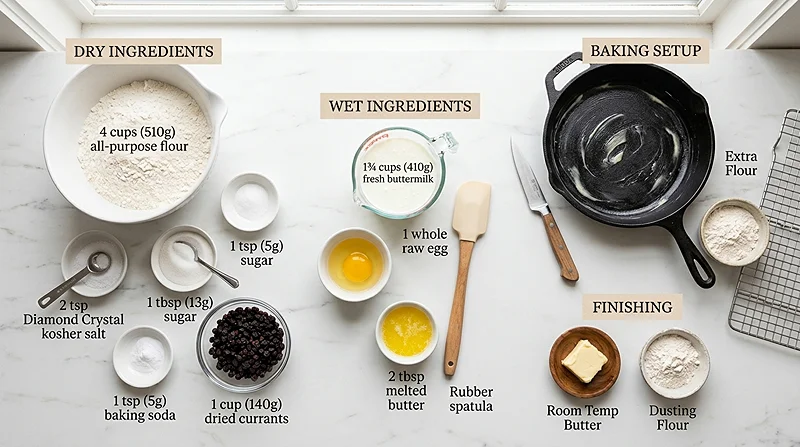
Ready to get into it? For this traditional irish soda bread, you only need a handful of real, simple ingredients — nothing fancy, nothing weird.
For the dry ingredients — all-purpose flour, kosher salt, sugar, and baking soda — you’ll whisk them together right in the mixing bowl.
For the wet ingredients — egg, buttermilk, and melted butter — you’ll combine them separately before bringing everything together. The currants are optional, but honestly? They add the most delightful little pops of sweetness. Do it.
| Amount | Ingredient |
|---|---|
| 4 cups (510 g) | All-purpose flour (see notes for whole grain swap) |
| 2 tsp (12 g) | Diamond Crystal kosher salt |
| 1 tbsp (13 g) | Sugar |
| 1 tsp (5 g) | Baking soda |
| 1 cup | Dried currants (optional, but highly encouraged) |
| 1 large | Egg |
| 1¾ cups (410 g) | Buttermilk (see notes below) |
| 2 tbsp | Melted butter |
| For finishing | Room temperature butter + a little flour |
A note on buttermilk: No buttermilk? No problem. Add 1 tablespoon of white vinegar or lemon juice to a measuring cup, then fill to 1¾ cups with regular whole milk. Let it sit for 5 minutes and you’ve got a perfect substitute.
A note on flour: You can swap up to half the all-purpose flour for whole wheat flour for a heartier, more rustic loaf. Just expect a slightly denser crumb — in the best possible way.
Tools You’ll Actually Use
- 9- or 10-inch cast iron skillet (or any oven-safe round baking dish)
- Large mixing bowl
- Medium mixing bowl
- Whisk
- Rubber spatula
- Sharp knife (for scoring the X)
- Cooling rack
- Measuring cups and spoons
Optional but nice: kitchen scale for more precise measurements
Step-by-Step Instructions
Let’s bake this irish soda bread recipe from start to finish — and I promise, this is genuinely one of the easiest things you’ll ever make.
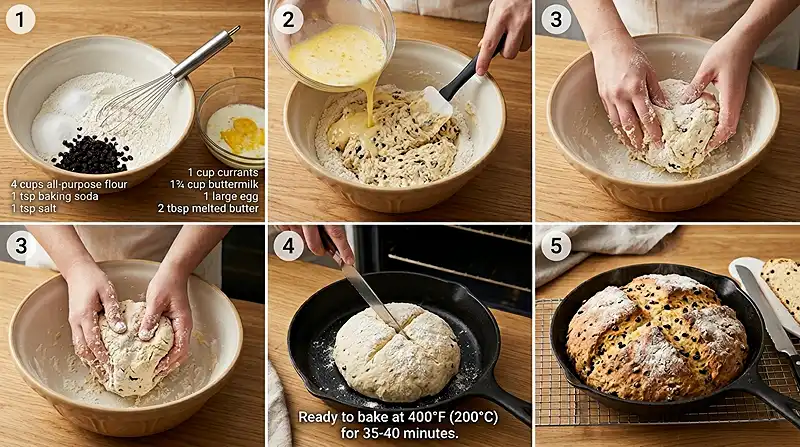
Step 1: Preheat your oven. Set your oven to 400ºF and let it fully come to temperature before the bread goes in. A hot oven is key to getting that gorgeous, golden crust.
Step 2: Whisk the dry ingredients. In a large mixing bowl, whisk together 4 cups all-purpose flour, 2 teaspoons kosher salt, 1 tablespoon sugar, and 1 teaspoon baking soda until evenly combined. If you’re using dried currants, stir them in now so they’re distributed throughout the dough from the start.
Step 3: Mix the wet ingredients. In a separate medium bowl, beat the egg lightly, then pour in 1¾ cups buttermilk and 2 tablespoons melted butter. Stir everything together until combined.
Step 4: Bring it together. Pour the wet ingredients into the dry ingredients and use a rubber spatula to stir until just combined. The mixture will be sticky — that’s completely normal and exactly what you want. Don’t overmix; you’re not going for smooth, you’re going for shaggy and just-come-together.
Step 5: Prepare your skillet. Grease a 9- or 10-inch cast iron skillet generously with room temperature softened butter. Set it aside on the counter while you shape the dough.
Step 6: Shape the dough. Lightly flour your hands and dust a tiny bit of flour over the sticky dough ball. Use your hands to scrape the dough from the bowl sides and quickly shape it into a rough ball — kneading it lightly just once or twice if needed.
Don’t overwork it. Transfer it into your prepared skillet. It doesn’t need to be perfect; rustic is the whole vibe here.
Step 7: Score and dust. Sprinkle the top of your dough ball with just a little extra flour for that beautiful, classic look. Then use a sharp knife to cut a deep X across the top — this helps the bread bake through evenly and is traditionally said to “let the fairies out.” (I don’t make the rules.)
Step 8: Bake until golden. Place the skillet in the preheated oven and bake for 35 to 40 minutes, until the loaf is lightly golden on top and the bottom sounds hollow when you tap it. Your kitchen will smell absolutely incredible — warm, wheaty, and buttery, like a bakery on a cobblestone street.
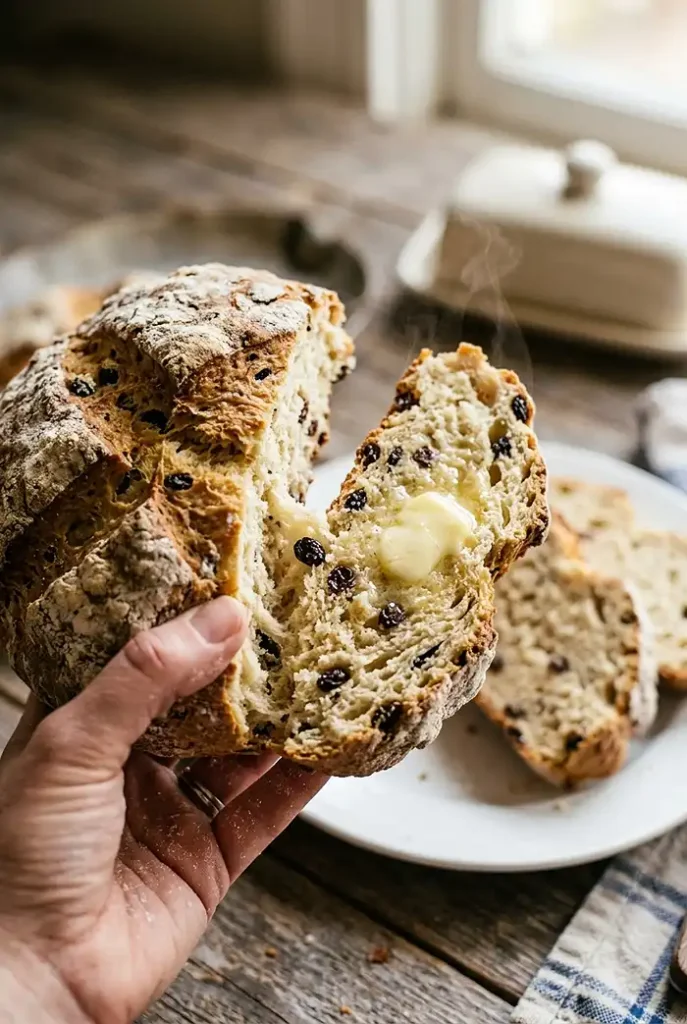
Step 9: Cool before slicing. Remove from the oven and transfer the loaf to a cooling rack. Let it cool for at least 15 minutes before slicing. I know. It’s hard. But slicing too early means the crumb is still setting, and you’ll end up with a gummy center instead of that perfect tender texture.
Claire’s Pro Tips & Gentle Guidance
Even this easy irish soda bread has a few little tricks that make the difference between “pretty good” and “oh my gosh, I need another slice.” These are the things I’ve learned from making this loaf more times than I can count — including the batches that didn’t go exactly as planned.
Don’t overmix the dough. Stirring too much develops the gluten and makes the bread tough. The moment you don’t see dry flour pockets anymore? Put the spatula down. Sticky is your friend.
Cold buttermilk is fine, but room-temp is better. If you have a few extra minutes, let your buttermilk and egg sit on the counter for about 20 minutes before using. It helps the baking soda activate more evenly for a better rise.
Use a sharp knife for the X. A dull knife drags and compresses the dough instead of cleanly cutting it. One confident, swift motion per cut — just like you mean it.
Cast iron is your best friend here. The cast iron skillet retains heat beautifully and gives the bottom of the bread an incredibly crispy crust. If you don’t have one, an oven-safe round cake pan or Dutch oven works, but cast iron is the move if you have it.
As King Arthur Baking explains in their classic soda bread recipe guide, the right vessel and oven temperature are what transform simple pantry ingredients into a genuinely spectacular loaf.
Tap the bottom to check for doneness. Slide the loaf out of the skillet and give the bottom a tap with your knuckles — if it sounds hollow, it’s done. If it sounds dense and thuddy, pop it back in for another 3–5 minutes.
Quick Fixes for Irish Soda Bread
Even the simplest recipes have their moments. Here’s how to troubleshoot your irish soda bread if something seems off:
Problem: The bread is too dense. You likely overmixed the dough or used old baking soda. Mix only until the ingredients are just combined — lumpy is okay! And if your baking soda has been in the cabinet since 2021, it’s time for a fresh box.
Problem: The crust is too dark but the center isn’t cooked. Your oven is probably running hot. Tent the bread loosely with a piece of aluminum foil halfway through baking to protect the top while the inside finishes cooking.
Problem: The dough is way too sticky to handle. This is actually normal — but if it’s genuinely unmanageable, dust a little more flour over the top before shaping. Avoid adding flour directly into the dough itself; that can throw off the texture.
Problem: The bread tastes flat or metallic. This usually means the baking soda ratio is off or the buttermilk wasn’t acidic enough to fully neutralize it. Use real buttermilk when possible, and measure your baking soda carefully — more is not more here.
Problem: The X didn’t open up while baking. Your cut probably wasn’t deep enough. Aim for about ½ to ¾ inch deep — don’t be shy about it. A hesitant little scratch on the surface won’t do the job.
There’s a whole world of quick breads & loaves waiting for you over at the Quick Breads & Loaves collection. Each one is made with the same love and attention, and they’re all absolutely worth trying. Happy cooking!
Variations & Fun Twists
This classic irish soda bread recipe is a beautiful base, and there are so many ways to make it your own.
Add caraway seeds for a more traditional, slightly savory flavor. Stir in about 1 tablespoon along with the dry ingredients.
Swap currants for raisins if that’s what you’ve got. Golden raisins are especially lovely here.
Make it whole grain by replacing up to 2 cups of the all-purpose flour with whole wheat flour. The bread will be heartier and slightly nuttier in flavor — absolutely delicious toasted with butter and jam.
Go dairy-free by using a plant-based buttermilk substitute (1¾ cups oat milk + 1 tablespoon apple cider vinegar, left to curdle for 5 minutes) and vegan butter. The texture will be very similar and still delicious.
Mini loaves for gifting: Divide the dough into two smaller rounds and bake on a greased baking sheet at 400ºF for about 25–28 minutes. Wrap in parchment and twine for the sweetest little edible gift.
Serving, Storage & Reheating
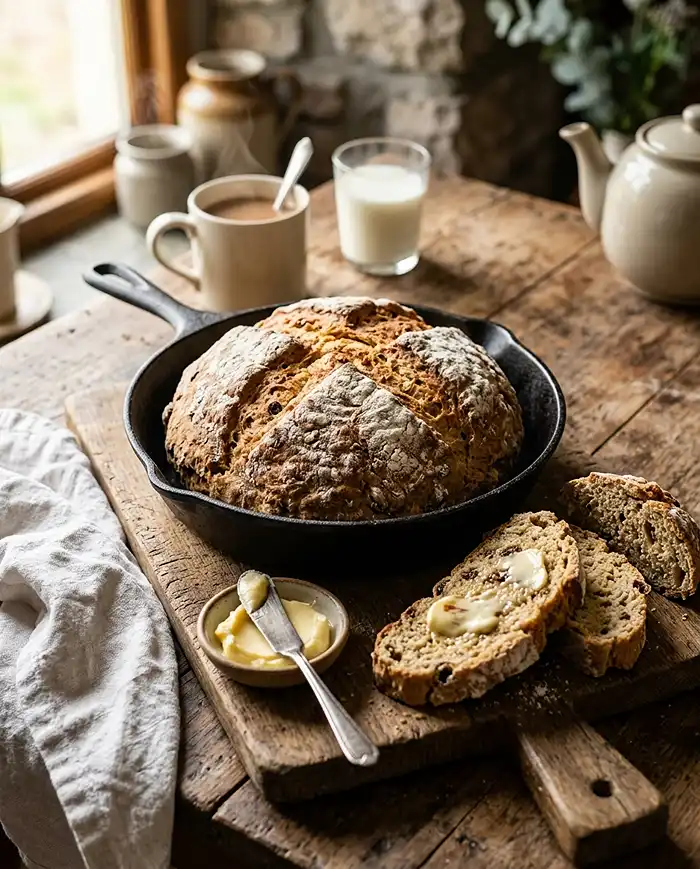
This traditional irish soda bread is honestly incredible the day it comes out of the oven — warm, crusty, and practically begging for a thick swipe of cold butter. Serve it alongside a bowl of soup, a warm pot of tea, or just on its own as a snack.
It also pairs beautifully with grilled chicken dishes or alongside something light and fresh like salmon with mango salsa.
Storage: Tuck your cooled loaf into an airtight zip-lock bag or airtight container. It’ll keep at room temperature for about 3–4 days. The crust will soften a little overnight, but it’s still delicious — especially toasted.
Freezing: Wrap the fully cooled loaf (or individual slices) tightly in plastic wrap, then in foil or a freezer bag. It freezes beautifully for up to 2–3 months. Thaw at room temperature or overnight in the fridge.
Reheating: For a whole loaf or large piece, wrap in foil and warm in a 350ºF oven for about 10 minutes. For individual slices, pop them in the toaster or a dry skillet over medium heat. A warm slice of this bread with room-temperature butter is genuinely one of life’s great simple pleasures.
No-Waste Kitchen Magic
Got a day-old loaf that’s gone a little soft? Don’t toss it — transform it.
Soda bread croutons: Cube the leftover bread, toss with olive oil, garlic powder, and a pinch of salt, and toast at 375ºF for 12–15 minutes until golden and crunchy. They’re incredible on soups and salads.
French toast with a twist: Thick slices of slightly stale soda bread make the most gorgeous, custardy French toast. The denser crumb absorbs the egg mixture beautifully without falling apart.
Bread crumbs: Blitz dried-out soda bread in a food processor for rustic, slightly sweet breadcrumbs. Use them as a topping for baked mac and cheese or a gratin — the currants add a surprising little pop of sweetness that’s completely addictive.
Butter it and freeze it: If you know you won’t finish the loaf, slice it, butter each slice, and freeze them flat on a baking sheet before transferring to a bag. Future you will be so grateful.
FAQs
Can I make this irish soda bread without buttermilk?
Yes, absolutely! To substitute, add 1 tablespoon of white vinegar or fresh lemon juice to a measuring cup, then fill to the 1¾-cup mark with regular whole milk. Stir and let it sit for about 5 minutes until it curdles slightly. It works just as well as the real thing and you probably won’t notice a difference.
What’s the best way to store irish soda bread?
The best way to store it is in an airtight bag or container at room temperature, where it’ll stay fresh for 3–4 days. For longer storage, wrap it tightly and freeze for up to 2–3 months. Avoid the fridge — it actually dries the bread out faster than leaving it on the counter.
How do I know when irish soda bread is done baking?
The top should be lightly golden and the loaf should feel set (not jiggly) when you gently press the center. The most reliable test is to remove the loaf from the skillet and tap the bottom — a hollow sound means it’s fully baked through. If it sounds solid, return it to the oven for 3–5 more minutes.
Why should I use buttermilk in irish soda bread?
Buttermilk is the secret weapon here because its natural acidity reacts with the baking soda to create carbon dioxide — that’s what makes the bread rise without any yeast. It also adds a subtle tang that’s essential to the classic flavor. Skipping it (or using regular milk without an acid) will give you a flat, dense loaf.
Cozy Closing
This irish soda bread recipe is the kind of thing that makes you feel like a bread-baking genius even if it’s your very first loaf — and I love that so much about it. No special skills, no fancy equipment, just a good bowl, a hot cast iron, and a willingness to let something simple be truly wonderful.
I’d love to see your spin on this irish soda bread! Drop a comment below with your photos — did you add currants? Go whole grain? Sneak in some caraway seeds? I’d love to see how you made it your own. This irish soda bread recipe is so versatile; I bet you’ve already got a delicious variation brewing in your head right now.
I’m Claire Whitmore — a dessert daydreamer and bread enthusiast from Asheville, NC. For me, baking isn’t about perfect loaves — it’s about the smell of something wonderful coming out of the oven and the joy of sharing it warm. (And maybe sneaking the heel of the bread before anyone else gets to it.)
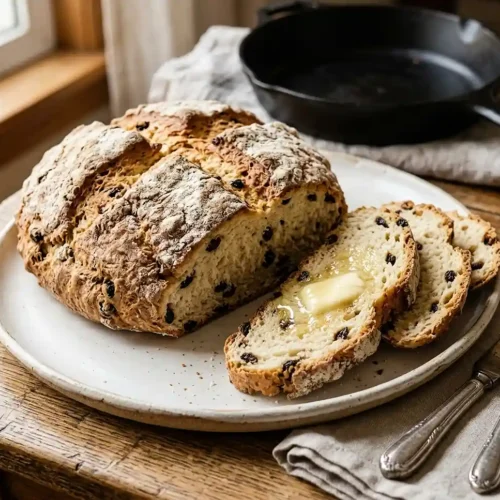
Irish Soda Bread
Equipment
- 9- or 10-inch cast iron skillet
- Large mixing bowl
- Medium mixing bowl
- Whisk
- Rubber spatula
- Sharp knife
- cooling rack
- Measuring cups and spoons
Ingredients
For the Irish Soda Bread
- 4 cups All-purpose flour 510g; see notes for whole grain swap
- 2 tsp Diamond Crystal kosher salt 12g
- 1 tbsp Sugar 13g
- 1 tsp Baking soda 5g
- 1 cup Dried currants optional but highly encouraged
- 1 Egg large
- 1¾ cups Buttermilk 410g; see notes for substitute
- 2 tbsp Melted butter
For Finishing
- Room temperature butter for greasing the skillet
- All-purpose flour for dusting the dough top
Instructions
- Preheat your oven to 400ºF and let it fully come to temperature before the bread goes in. A hot oven is key to getting that gorgeous, golden crust.
- In a large mixing bowl, whisk together 4 cups all-purpose flour, 2 teaspoons kosher salt, 1 tablespoon sugar, and 1 teaspoon baking soda until evenly combined. If you’re using dried currants, stir them in now so they’re distributed throughout the dough from the start.
- In a separate medium bowl, beat the egg lightly, then pour in 1¾ cups buttermilk and 2 tablespoons melted butter. Stir everything together until combined.
- Pour the wet ingredients into the dry ingredients and use a rubber spatula to stir until just combined. The mixture will be sticky — that’s completely normal and exactly what you want. Don’t overmix; you’re not going for smooth, you’re going for shaggy and just-come-together.
- Grease a 9- or 10-inch cast iron skillet generously with room temperature softened butter. Set it aside on the counter while you shape the dough.
- Lightly flour your hands and dust a tiny bit of flour over the sticky dough ball. Use your hands to scrape the dough from the bowl sides and quickly shape it into a rough ball — kneading it lightly just once or twice if needed. Don’t overwork it. Transfer it into your prepared skillet.
- Sprinkle the top of your dough ball with just a little extra flour. Then use a sharp knife to cut a deep X across the top — about ½ to ¾ inch deep — in two confident, swift cuts. This helps the bread bake through evenly.
- Place the skillet in the preheated oven and bake for 35 to 40 minutes, until the loaf is lightly golden on top and the bottom sounds hollow when you tap it.
- Remove from the oven and transfer the loaf to a cooling rack. Let it cool for at least 15 minutes before slicing to allow the crumb to fully set.